Here is the PowerPoint we saw in class. Good luck, everyone!
Mostrando entradas con la etiqueta English. Mostrar todas las entradas
Mostrando entradas con la etiqueta English. Mostrar todas las entradas
lunes, 22 de mayo de 2017

miércoles, 17 de mayo de 2017
Your last practice test
I am going to give you one last practice exam (Reading and Writing) to do before we have the PET/KET Reading and Writing parts on Tuesday.
6ºA will start it in class on Thursday, and 6ºB will start it on Friday after the Speaking exams. Please finish it at home. We will check it on Monday.
6ºA will start it in class on Thursday, and 6ºB will start it on Friday after the Speaking exams. Please finish it at home. We will check it on Monday.
martes, 16 de mayo de 2017
Writing practice for your exam
Here is some good information to help you on the writing part of your exam.
Vocabulary practice for PET and KET!
Unfortunately, we are still not able to use our computers at school. However, I will share here some very useful links.
Here are some links to practice vocabulary for your test. Have a look at them!
Vocabulary for PET Each of the topics have a 20-question quiz. Try them all!
Objective PET Vocabulary Trainer (this one does not work in Chrome)
50-question quiz for KET
Vocabulary for KET
Here are some links to practice vocabulary for your test. Have a look at them!
Vocabulary for PET Each of the topics have a 20-question quiz. Try them all!
Objective PET Vocabulary Trainer (this one does not work in Chrome)
50-question quiz for KET
Vocabulary for KET
Verbs and prepositions
It can be hard to remember which verbs go with which prepositions. Here is an inforgraphic to help you:


Two games to practice-- these won't work on mobile devices :-(
sábado, 13 de mayo de 2017
Free app from Cambridge to practice English!
Cambridge English has made a free app for students to play to practice their English.
It is for level B1-B2 (PET is level B1).
You can download it here:
Quiz Your English!
Also, don't forget the free writing practice site from Cambridge:
Write and Improve
Have fun!
It is for level B1-B2 (PET is level B1).
You can download it here:
Quiz Your English!
Also, don't forget the free writing practice site from Cambridge:
Write and Improve
Have fun!
jueves, 4 de mayo de 2017

lunes, 24 de abril de 2017
A great website for writing practice!
Here is a great website from Cambridge to practice your writing. And, it's free!
https://writeandimprove.com/
You should start with the W&I Beginner tasks, and then you can try the Intermediate ones.
Give it a try!
https://writeandimprove.com/
You should start with the W&I Beginner tasks, and then you can try the Intermediate ones.
Give it a try!
jueves, 6 de abril de 2017
Review!
Please practice with these exercises:
Present simple
Prepositions of time
Countable and uncountable nouns
Pronouns
Verbs
Present simple
Prepositions of time
Countable and uncountable nouns
Pronouns
Verbs
domingo, 2 de abril de 2017
Spiral Review Homework for the holiday
You will have some English homework for the holiday. It is to help you review, and it is about things we have studied in class this year.
After the break we will continue to do weekly homework in this way.
- On Monday, 3rd April I will give you your homework sheet for the holidays. Do the homework on notebook paper or blank white paper.
- You must hand it in on Tuesday, 18th April. Staple the homework sheet to the completed pages.
- You must use your notes and the blog to review the grammar before doing the exercises.
- Together with another weekly homework sheet after the holidays, it will count as a test grade (0,5 pts each week.) This means it is like having a test where you get to use your book and notebook!
- Later I will publish a post in the blog with the links that will help you for the week.
After the break we will continue to do weekly homework in this way.
Para English, vamos a empezar a repasar un poco todos los días con un "repaso en espiral." Es una hoja de deberes para completar a lo largo de la semana, sobre cosas que ya hemos visto en clase (este curso, o el curso pasado). En clase seguiremos trabajando sobre listening, speaking, writing, y algunas cosas nuevas de gramática.
Los viernes os entregaré la ficha con los deberes "espiral" de la siguiente semana (aparte de eso, algunos días puede que también tengáis algún ejercicio más sobre lo que trabajamos en clase.) Me tenéis que entregar estos deberes el jueves siguiente en una hoja (u hojas) grapada a la ficha. Es muy importante que revisáis los apuntes sobre la gramática antes de realizar los ejercicios (también podáis hacer los juegos del blog.) Cada semana vale como la mitad de un examen, lo que os beneficia porque es como hacer el examen con los apuntes delante. Debéis guardar los deberes corregidos (junto con sus fichas) todos juntos en una funda de plástica que llevaréis en la carpeta todos los días.
Os podéis organizar como queráis para hacer los deberes (un ejercicio cada día, o si un día estáis muy ocupados, hacer dos ejercicios el mismo día, etc.)
Debido a las vacaciones, esta semana será un poco distinto: os doy la ficha el lunes 3 de abril y me lo devolvéis el martes 18 de abril.
Debido a las vacaciones, esta semana será un poco distinto: os doy la ficha el lunes 3 de abril y me lo devolvéis el martes 18 de abril.
martes, 28 de marzo de 2017
Forming questions
Do you remember QUASI?

He helps us remember how to make questions:
QU is for Question word:
What
Where
Why
Who
How long
How old
etc.
A is for Auxiliary:
do/does/did
am/is/are/was/were
has/have/had
can/should/must/will/would
S is for Subject:
I/you/he/she/it/we/they
my aunt
Billy
the teacher
the cat
I is for Infinitive:
go play have eat do run drive feel study
Ex: Who (QU) did (A) she (S) meet (I) at the park?
What (QU) should (A) we (S) do (I) after school?
We don't have to use a question word-- we can start directly with the auxiliary for yes/no questions.
Did (A) she (S) meet (I) them at the park yesterday?
There is another way to remember: QUASM.
The M is for Main verb, because sometimes we use a past participle (eaten, taken, studied) or present participle (watching, running, taking).
For example:
What time (QU) are (A) you (S) going (M) to the party?
How long (QU) have (A) they (S) been waiting (M) here?
Read this link for some examples and then a quiz at the end:
An easy way to form (almost) any question in English
Page of links to exercises 1
Page 2
He helps us remember how to make questions:
QU is for Question word:
What
Where
Why
Who
How long
How old
etc.
A is for Auxiliary:
do/does/did
am/is/are/was/were
has/have/had
can/should/must/will/would
S is for Subject:
I/you/he/she/it/we/they
my aunt
Billy
the teacher
the cat
I is for Infinitive:
go play have eat do run drive feel study
Ex: Who (QU) did (A) she (S) meet (I) at the park?
What (QU) should (A) we (S) do (I) after school?
We don't have to use a question word-- we can start directly with the auxiliary for yes/no questions.
Did (A) she (S) meet (I) them at the park yesterday?
There is another way to remember: QUASM.
The M is for Main verb, because sometimes we use a past participle (eaten, taken, studied) or present participle (watching, running, taking).
For example:
What time (QU) are (A) you (S) going (M) to the party?
How long (QU) have (A) they (S) been waiting (M) here?
Read this link for some examples and then a quiz at the end:
An easy way to form (almost) any question in English
Page of links to exercises 1
Page 2


miércoles, 22 de marzo de 2017
A project to share with our friends in Bolton
We are going to do a project to share with our friends in Bolton, England. Here is the website of their school:
Bishop Bridgeman School
Here is where the school is located:

You must bring your photos and information to class on Monday, 27th March (6ºB) or Tuesday, 28th March (6ºA).
We will make the project in class.
Bishop Bridgeman School
Here is where the school is located:

We are going to tell them about the different Natural Parks in Spain. With your group, choose one of the parks from the list, and find out this information:
Natural Parks
in Spain
--map showing what part of Spain it is in
--What can you do there?
--Vegetation and animals
--Photos
You must bring your photos and information to class on Monday, 27th March (6ºB) or Tuesday, 28th March (6ºA).
We will make the project in class.
martes, 21 de marzo de 2017
lunes, 20 de marzo de 2017
Writing an email
On your English test this Thursday, you will have to write an email. You must include an opening or greeting, and a closing. Here are some examples that you can use:
|
Openings
|
Closings
|
|
Hi Bill,
Dear Mary,
Hi Steven!
Hey Barbara!
Hello Jill,
|
See you soon!
Love, Mary
All the best,
All my love,
Love and kisses,
Write back soon,
Bye for now!
Bye!
Best,
|
sábado, 18 de marzo de 2017
jueves, 16 de marzo de 2017
English Test 7 23rd March
We will have an English Test next Thursday, 23rd March.
You must study:
Present perfect continuous post
So and Neither post
From class:
Clothes vocabulary (post 1 and post 2 )
Verbs of obligation, prohibition, and advice: Must/mustn't; should/shouldn't; have to/ don't have to. click here video and explanation
Pronouns:
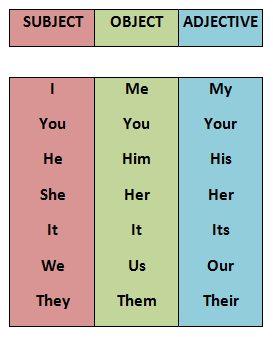
More pronoun practice!
For your test you have to review the irregular verbs from the last unit
(link to post with presentation)
and the ones from the story "Two Heroes":
You must study:
From the book:
--So do I, Neither do I: PB p. 88, WB p. 75 and notes in notebook
--Present perfect continuous; for and since: PB p. 87;
WB p. 74
--Use of apostrophes and irregular plurals (people,
children, men, women) WB p. 77
Present perfect continuous post
So and Neither post
From class:
Clothes vocabulary (post 1 and post 2 )
Verbs of obligation, prohibition, and advice: Must/mustn't; should/shouldn't; have to/ don't have to. click here video and explanation
Pronouns:
More pronoun practice!
For your test you have to review the irregular verbs from the last unit
(link to post with presentation)
and the ones from the story "Two Heroes":
martes, 14 de marzo de 2017

lunes, 13 de marzo de 2017
Writing practice
This is part of a letter you receive from your English friend Jo.
I'm sending a photo of myself wearing my favourite clothes. What do you like wearing the best? And where do you like buying your clothes-- in shops or online? Why?
Write a letter to Jo, answering the questions in the letter. It should be about 55 words long and must include a greeting and a closing. (How we start and finish a letter.)
I'm sending a photo of myself wearing my favourite clothes. What do you like wearing the best? And where do you like buying your clothes-- in shops or online? Why?
Write a letter to Jo, answering the questions in the letter. It should be about 55 words long and must include a greeting and a closing. (How we start and finish a letter.)
Suscribirse a:
Entradas (Atom)