You have your Natural Science test on Unit 3: Reproduction on Friday, 5th May.
We will correct the review sheet in class on Thursday (6ºB-- we will do Natural Science instead of Social Science on Thursday.)
You must study:
--The diagrams of the male and female reproductive systems (label and explain what each part does.)
--The chart on page 40 about the different life stages
--The two types of sexual characteristics (primary and secondary) and when they appear
--The menstrual cycle
--Puberty changes in girls and boys
--Genes: what they are and why they are important
--Pregnancy and birth
--Gender equality (p. 49)
Good luck!
Mostrando entradas con la etiqueta test review. Mostrar todas las entradas
Mostrando entradas con la etiqueta test review. Mostrar todas las entradas
martes, 2 de mayo de 2017

domingo, 23 de abril de 2017
Repaso Ciencia y Tecnología para la Reválida: El cuerpo humano
Aquí os pongo enlaces para recordar lo que hemos trabajado en Naturales, en español. Prestad atención especial a todo lo que se refiere a la aplicación práctica: cómo podemos cuidar los distintos sistemas de nuestro cuerpo, la salud y los primeros auxilios, etc.
El cuerpo humano:
Aparatos y órganos del cuerpo humano
La función de relación
Los sentidos
Aparato locomotor y nervioso
La musculatura
Esqueleto y músculos
El aparato digestivo
La digestion
Hábitos alimentarios saludables
Los alimentos, la dieta, y los deportes
El aparato respiratorio
La respiración
El aparato circulatorio
El aparato excretor 1
El aparato excretor (juego)
Aparatos y órganos de la función de nutrición (juego)
Aparato reproductor maculino
Aparato reproductor masculino (juego)
Aparato reproductor femenino 1
Aparato reproducror femenino 2
Aparato reproductor femenino (juego)
El ciclo menstrual
La fecundación humana
El embarazo
La reproducción y el embarazo
La pubertad y la salud
Las etapas de la vida
Salud y enfermedades
La salud
Mejoras en la salud y la alimentación
Medidas de prevención y primeros auxilios
Cómo podemos ayudar en un accidente
El cuerpo humano:
Aparatos y órganos del cuerpo humano
La función de relación
Los sentidos
Aparato locomotor y nervioso
La musculatura
Esqueleto y músculos
El aparato digestivo
La digestion
Hábitos alimentarios saludables
Los alimentos, la dieta, y los deportes
El aparato respiratorio
La respiración
El aparato circulatorio
El aparato excretor 1
El aparato excretor (juego)
Aparatos y órganos de la función de nutrición (juego)
Aparato reproductor maculino
Aparato reproductor masculino (juego)
Aparato reproductor femenino 1
Aparato reproducror femenino 2
Aparato reproductor femenino (juego)
El ciclo menstrual
La fecundación humana
El embarazo
La reproducción y el embarazo
La pubertad y la salud
Las etapas de la vida
Salud y enfermedades
La salud
Mejoras en la salud y la alimentación
Medidas de prevención y primeros auxilios
Cómo podemos ayudar en un accidente
miércoles, 19 de abril de 2017
Upcoming tests!
Here are some test dates to remember:
Wednesday, 26th April: test on EU countries (map) and capitals
Thursday, 27th April: hand in second Spiral Review homework (worth half of a test grade, to be combined with the homework from Semana Santa.)
Friday, 5th May: Natural Science Test Unit 3: Reproduction
Thursday, 11th May: Social Science Unit 7: The European Union
Wednesday, 26th April: test on EU countries (map) and capitals
Thursday, 27th April: hand in second Spiral Review homework (worth half of a test grade, to be combined with the homework from Semana Santa.)
Friday, 5th May: Natural Science Test Unit 3: Reproduction
Thursday, 11th May: Social Science Unit 7: The European Union
lunes, 17 de abril de 2017
Social Science Test: Countries and capitals
We will have two separate tests for Unit 7. The first one will be to locate on the map the 28 countries of the European Union.
You must also know their capitals, and the capitals of these non-EU countries:
--Switzerland
--Norway
The test will be Wednesday, the 26th of April.
You must also know their capitals, and the capitals of these non-EU countries:
--Switzerland
--Norway
The test will be Wednesday, the 26th of April.
martes, 21 de marzo de 2017
jueves, 16 de marzo de 2017
Social Science Unit 4
We will have one last Social Science test before the holidays. It will be on Unit 4, Landforms and territories of Europe.

You must know several definitions and also the map. Locate on the map:
You must know several definitions and also the map. Locate on the map:
Mountains: Ural,
Caucasus, Scandinavian, Grampian, Alps, Carpathian, Balkan, Pyrenees, Dinaric
Alps, Apennines, Massif Central
Peninsulas:
Kola, Crimean, Iberian, Balkan, Italian,
Scandinavian, Jutland
Islands: Sardinia, Corsica, Sicily, Crete, Azores, Cyprus,
British Isles, Iceland. Balearic
Capes: North, Saint
Vicent, Matapan, Fisterra
Gulfs: Bothnia, Bizkaia,
Lion, Genoa
Plains. Russian Plain, Great European Plain
Seas: Mediterranean,
Black, Caspian, Adriatic, North, Baltic, Cantabrian,Tyrrhenian.
Oceans: Atlantic, Artic
Peaks: Mont Blanc, Elbrus, Mulhacén, Aneto
Other: Strait of Gibraltar, English Channel, Asia, Africa
Map games to practice:
European Relief (What is it called?)
European Relief 2 (Where is it?)
Coasts of Europe 1 (What is it called?)
Coasts of Europe 2 (Where is it?)
The maps about the coasts have a lot of information that you don't need to memorise, but you can use the "Mirar" feature (instead of "Jugar") to practice!
After Semana Santa we will start to learn the countries of Europe (political map!)
Here is a presentation about Physical Geography of Europe. It includes rivers and climate (which we will learn about later!)
Map games to practice:
European Relief (What is it called?)
European Relief 2 (Where is it?)
Coasts of Europe 1 (What is it called?)
Coasts of Europe 2 (Where is it?)
The maps about the coasts have a lot of information that you don't need to memorise, but you can use the "Mirar" feature (instead of "Jugar") to practice!
After Semana Santa we will start to learn the countries of Europe (political map!)
Here is a presentation about Physical Geography of Europe. It includes rivers and climate (which we will learn about later!)
English Test 7 23rd March
We will have an English Test next Thursday, 23rd March.
You must study:
Present perfect continuous post
So and Neither post
From class:
Clothes vocabulary (post 1 and post 2 )
Verbs of obligation, prohibition, and advice: Must/mustn't; should/shouldn't; have to/ don't have to. click here video and explanation
Pronouns:
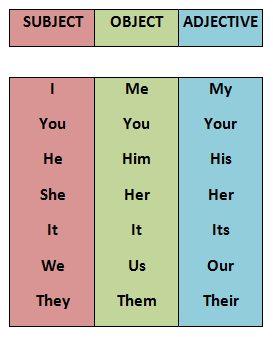
More pronoun practice!
For your test you have to review the irregular verbs from the last unit
(link to post with presentation)
and the ones from the story "Two Heroes":
You must study:
From the book:
--So do I, Neither do I: PB p. 88, WB p. 75 and notes in notebook
--Present perfect continuous; for and since: PB p. 87;
WB p. 74
--Use of apostrophes and irregular plurals (people,
children, men, women) WB p. 77
Present perfect continuous post
So and Neither post
From class:
Clothes vocabulary (post 1 and post 2 )
Verbs of obligation, prohibition, and advice: Must/mustn't; should/shouldn't; have to/ don't have to. click here video and explanation
Pronouns:
More pronoun practice!
For your test you have to review the irregular verbs from the last unit
(link to post with presentation)
and the ones from the story "Two Heroes":
sábado, 4 de marzo de 2017
Definitions for Social Science Unit 3
Hydrography—The geographical study of the waters of
the Earth.
Tributary (afluente)—A river that flows into another
river instead of draining into the sea.
Source (nacimiento)—Where the water emerges from the
earth to become a river
Mouth (desembocadura)—where the river ends
Channel (cauce)—where the river flows
Course (curso)—the path a river follows
Meanders—the curves in a river
Length—the distance between a river’s source and mouth
Discharge (caudal)—the amount of water flowing through
a river
Regime (régimen)—the discharge variation throughout
the year
Drainage basin (vertiente)—An area of land that drains
all of its water into the same ocean, sea, or sometimes lake.
Dam (presa)—Dams are built on rivers to create
reservoirs.
Reservoir (embalse)—water collected for human use
(consumption, irrigation, industrial use, or to generate energy)
Torrents—Natural, flowing streams of water created by
rain.
Ravines—Deep, narrow, steep-sided valleys formed by
running water
lunes, 20 de febrero de 2017
English Test 6 Review
Some of you asked me to put the PowerPoint we saw in class on the blog. So, here it is!
martes, 14 de febrero de 2017
English Test 6, Tuesday 21st February
The next test will have some things from the book and some things from class.
Notebook and class:
--Making and
responding to suggestions
--Adverbs of
frequency (use and meaning)
English World:
--Present simple vs.
present continuous (Unit 6 p.70, WB p. 55) practice here
--Direct and indirect
objects (Unit 7 p.79, WB p. 64)
--Spelling: double
consonants (Unit 7 p.81, WB p. 67)
Grammar Review:
--Comparatives,
superlatives (practice here and also here)
--too much/too
many/enough (practice here)
--irregular verb form
and meaning: take, break, give, hide, bring, drop, tear, ride, see, find, lose,
fall
Writing:
--Describing a person
This time there will be no listening or reading.
Here is a presentation to study the verbs.
miércoles, 1 de febrero de 2017
Social Science Units 1 & 2 Review questions
Review Unit 1
& 2 Social Science
Definitions:
ría
coastal bench
depression
salt marsh
freshwater lagoon
Mountains:
--Which mountain
system divides the Meseta in half?
--Which is the
highest peak in that system?
--Which mountain
system separates the Tajo Valley from the Guadiana Valley? Which sub-plateau is it located in?
--What is the highest
summit in the Cantabrian Range? Where is it located?
--Which mountain
range contains the Moncayo Peak?
--Which mountains
separate the Meseta from the Guadalquivir Valley?
--Which is the
highest peak in the Pyrenees?
--What is the Baetic
System made up of?
Rivers:
--What landform is
found at the mouth of the Ebro river?
How is it formed?
--What landform is
found at the mouth of the Guadalquivir River? How is it formed?
--Where is the Doñana
National Park?
-- Which ocean do the
rivers on the Meseta flow into? Why?
Explain:
--What are the three
factors that determine coastal features? Explain how for each one.
--What are the
geographic borders of Spain?
--What does the
Spanish territory consist of?
Where can we find:
--rías
--salt marshes
--coastal benches
--freshwater lagoon
(an example)
Balearic Islands:
--Where are they and
what is each one called?
--Mountain ranges
from the Peninsula that have an extension in the Balearic Islands
--Name of the
mountain range in Mallorca
Canary Islands:
--Where are they
located? Name of each island
--How were they
formed?
--Characteristic
landforms
--Important peak
Locate on the map:
Capes: Peñas, Fisterra, Creus, Palos, Gata and Nao.
Gulfs: Bizkaia, Valencia and Cádiz. Mar Menor and Strait of
Gibraltar
Inland relief: Galician Massif, Cantabrian Range, Northern
Sub-Plateau, Mountains of León, Basque Mountains, Catalan C. Range, Pyrenees,
Iberian System, Sierra Morena, Central System, Southern Sub-Plateau, Toledo
Mountains, Ebro Depression, Guadalquivir Depression, Penibaetic Range,
Subbaetic range, Gredos, Somosierra, Guadarrama, Picos de Europa, Sierra
Nevada, Tramuntana Range, Teide Peak, Almanzor Peak, Moncayo Peak, Aneto Peak,
Torreceredo Peak and Mulhacén Peak.
Islands:
Menorca, Formentera, Mallorca, Ibiza, La Palma, El Hierro, La Gomera, Tenerife,
Gran Canaria, Lanzarote and Fuerteventura.
lunes, 23 de enero de 2017
Practice for English test.
Try this game to practice "and" "but" "or"
Expressions with "look". There are a few we didn't study! Also, you need to know "look like" and "look at" and "look around"

Comparatives and superlatives:
Expressions with "look". There are a few we didn't study! Also, you need to know "look like" and "look at" and "look around"

Comparatives and superlatives:
viernes, 20 de enero de 2017
English test Friday, 27th January
Hello everybody! We are going to have an English test next Friday. There will be some reading comprehension, some listening, some writing, and some other exercises:
--Past perfect with "that" (WB p. 44, p.50; Pupil's Book p.61)
--Comparative: --er than; more..... than; as...as; not as ....as (notebook)
--Agreeing and disagreeing (WB p. 45; Pupil's book p. 62; notebook)
--and/but/or (WB p. 47)
--phrasal verbs with "look" (we will do this next week!)
Good luck!
--Past perfect with "that" (WB p. 44, p.50; Pupil's Book p.61)
--Comparative: --er than; more..... than; as...as; not as ....as (notebook)
--Agreeing and disagreeing (WB p. 45; Pupil's book p. 62; notebook)
--and/but/or (WB p. 47)
--phrasal verbs with "look" (we will do this next week!)
Good luck!
domingo, 15 de enero de 2017
viernes, 13 de enero de 2017
Natural Science Unit 1 Test Review
For your test on Friday, you need to know:
Read and discover
p.6
Parts of the
Central Nervous System
Parts of the brain
and what each one does
Parts of the
Peripheral Nervous System and what each one does
How do we respond to a stimulus?
Parts of the eye
Explain how we see
Parts of the ear
Nose and mouth
Explain how we
smell and taste
The skin
Explain how our
sense of touch works
Label the bones
Explain the three
types of bones
Label the muscles
Difference between
ligament and tendon
Types of joints
with examples
Types of muscles
with examples
Voluntary and
involuntary muscles
Healthy habits for the
locomotor system
domingo, 11 de diciembre de 2016
Social Science review questions
On Wednesday you have your last test of the trimestre: Social Science! You must be able to locate and label all of the provinces of Spain (I will give you a list.)
Also you must study about how our government is organised. Here are the review questions to help you. All of the answers are in your book.
Also you must study about how our government is organised. Here are the review questions to help you. All of the answers are in your book.
1. What is the city council formed by?
2. What are the
three bodies of government within an autonomous community?
3. What is the
Statute of Autonomy?
4. Name four
things included in the Statute of Autonomy?
5. How does the Constitution
define Spain? Where does its sovereignty reside? How is it organized?
6. How many
autonomous communities are in Spain?
7. Name the two
autonomous cities.
8. What are the
State Institutions established by the Constitution?
9. What is the
function of the Head of State? Who is
it?
10. Which
institution holds the executive power?
What is its mission? What is it formed by?
11. What is the
Parliament in charge of? What kind of
power do they hold? What are its two chambers?
12. Which
institution holds the judicial power? What are they in charge of? What are the
main courts of justice in Spain?
lunes, 5 de diciembre de 2016
viernes, 2 de diciembre de 2016
miércoles, 30 de noviembre de 2016
A real bear footprint-- and your last English test of the trimestre
Here is the picture my friend took while she was walking in the mountains over the weekend. It is from a black bear. Luckily she didn't see the bear!

Here is an article about what you should do if you meet a bear.
The last English test of the trimestre will be on Wednesday, 7th December.
It will include some things from the last exam:
--Present continuous, sentences and questions.
--Reported speech and direct speech
And some things from Units 3 and 4:
--Past perfect: had + past participle click here
--Question tags (isn't it/he/she? is it/he/she? aren't you/they/we? are you/they/we?
wasn't it/he/she? was it/he/she? weren't you/they/we? were you/they/we?)
--Asked someone to/ told someone to...
--And/so/but/because (click here)
And a Listening exercise, a writing exercise.
Very important! Review your irregular verbs!!!!
Here is an article about what you should do if you meet a bear.
The last English test of the trimestre will be on Wednesday, 7th December.
It will include some things from the last exam:
--Present continuous, sentences and questions.
--Reported speech and direct speech
And some things from Units 3 and 4:
--Past perfect: had + past participle click here
--Question tags (isn't it/he/she? is it/he/she? aren't you/they/we? are you/they/we?
wasn't it/he/she? was it/he/she? weren't you/they/we? were you/they/we?)
--Asked someone to/ told someone to...
--And/so/but/because (click here)
And a Listening exercise, a writing exercise.
Very important! Review your irregular verbs!!!!
lunes, 24 de octubre de 2016
English Test
You will have your English test on November 3rd.
It will be on:
Reported Speech de Miguel Dias

It will be on:
- Present continuous form to talk about future plans. (Review here)
- What a/ What an/ What exclamations (Review in your book and workbook)
- Reported speech (See presentation below)
- Too/ too much/ very (Review here)
- Time expressions (See below)
- A listening exercise
- A reading comprehension exercise
- A writing exercise
Reported Speech de Miguel Dias
Time expressions with prepositions:
in the
morning in the afternoon in the evening
at
night at 6 o’ clock on Friday
in
2016 in July in the summer
in two
weeks in five minutes in the future
Suscribirse a:
Entradas (Atom)